Vented vs. ventless dryers: compare installation before savings
Compare vented, condenser and heat-pump dryer choices using your exhaust route, electrical supply, loads, maintenance and full installation quote.
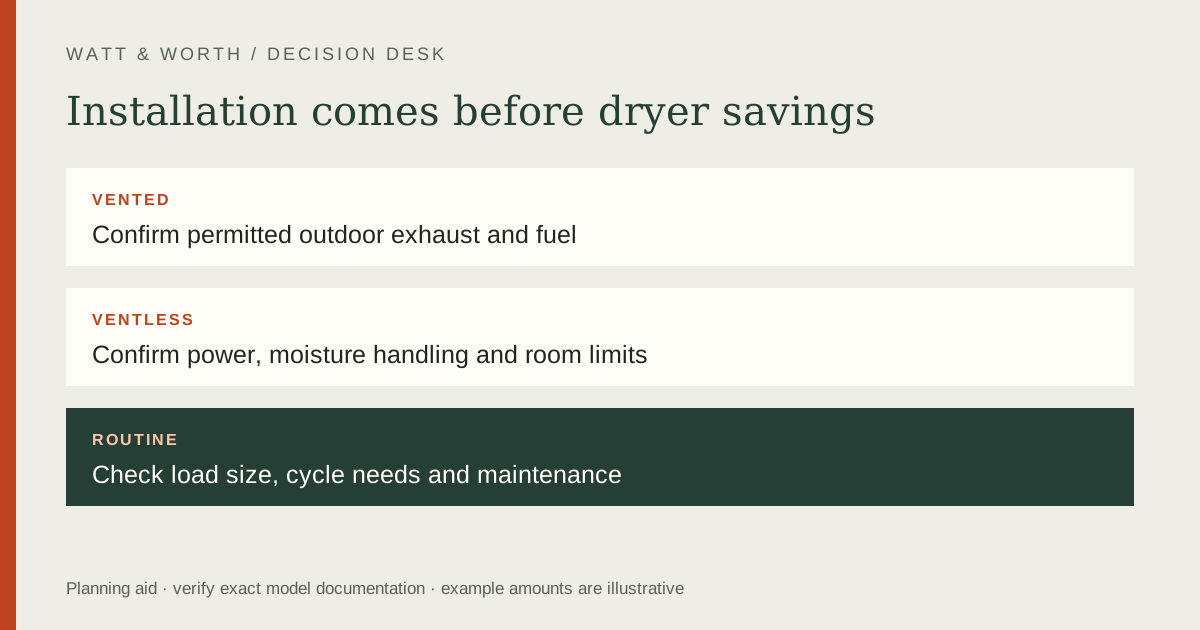
Choose a dryer only after confirming the installation path. An existing outdoor exhaust, available electrical or gas service, drainage and room conditions can determine which models are practical. Compare energy and cycle information after those checks. A ventless label or a high-efficiency claim does not mean a dryer can be placed anywhere without reading the manual.
Map the existing laundry setup
Photograph the current model plate, connection area and visible exhaust route without moving equipment unsafely. Note whether the existing unit is electric or gas. Ask a qualified installer to identify the requirements for a replacement. Do not infer an acceptable connection from the shape of a plug in an online photograph.
For a vented model, the permitted duct material, route and length are model-specific installation questions. For a ventless model, check how moisture is collected or drained and what room clearances or ambient conditions are specified. Some installations require more space than the appliance body suggests.
If you rent, obtain permission for alterations and clarify who pays for them. A dryer that makes sense in a house with a dedicated laundry area may be unsuitable in an apartment closet. Avoid committing to a type before the property constraints are known.
Understand the options without assuming identical performance
| Type | Key installation issue | Ownership question |
|---|---|---|
| Vented electric | Electrical supply and outdoor exhaust | What will vent inspection and upkeep involve? |
| Vented gas | Gas, electricity and outdoor exhaust | Who is qualified to connect and service it? |
| Ventless condenser | Power, moisture handling and room conditions | How is collected water managed? |
| Ventless heat pump | Power, drainage or tank and clearances | What filters and heat-exchanger care are required? |
| Combination washer-dryer | Supply, drainage and mode requirements | Does drying capacity suit the wash routine? |
This table describes what to verify, not which type will be cheapest or fastest. Check the exact model documentation. Similar product names can hide differences in capacity, connection requirements or maintenance access.
Try to find cycle guidance for the loads you dry most often. An advertised quick cycle may cover a smaller load than your normal basket. If laundry is done back to back, consider the whole sequence from washing through drying and unloading.
Compare energy and useful capacity together
ENERGY STAR's dryer guidance explains Combined Energy Factor and notes the importance of matching the drum to the load. Use the relevant model data, and compare like fuel types carefully. A gas dryer comparison may require both gas and electricity costs rather than a single kWh calculation.
Illustrative electricity-only example: an assumed 500 kWh annual difference at $0.16 per kWh produces $80 per year in savings. If the more efficient option costs $600 extra after installation, simple payback is $600 ÷ $80 = 7.5 years. This is not a claimed savings rate for any type or model.
Ask whether your energy estimate represents your expected number of loads. If you line-dry part of the laundry, a standard annual-use assumption may overstate the benefit of a more efficient dryer. Keep both the original model figure and your adjusted scenario so the comparison remains transparent.
Price the complete installation
Request separate lines for the appliance, delivery, connection materials, installation, any vent or drainage work, permits if applicable and haul-away. A sales price that excludes essential work is not comparable to a complete installed quote. Clarify whether the installer inspects the existing arrangement before the delivery date.
Do not budget a generic national price for a local alteration. Existing conditions can change the scope. When electrical, gas or building work is involved, obtain qualified local advice and a written estimate. If the quote depends on an inspection, keep the amount provisional until that inspection occurs.
For stacked installations, verify the exact approved washer-dryer pairing and stacking kit. Include access to controls, filters and service areas in the room plan. A pair that fits the height may still be impractical if regular maintenance requires moving heavy equipment.
Plan for care and interruptions
Read the maintenance section before purchase. Identify which filters need attention, how frequently the manufacturer says to check them and whether the user can reach them in the proposed location. A feature that saves space can still be inconvenient if ordinary care is difficult.
Ask who services the particular model in your area. Availability of an authorized service route is a different question from a warranty's printed duration. Save the warranty and clarify parts, labor and visit charges rather than assuming that all repair costs are included.
Keep a backup drying plan for an installation delay. Arrange the order so you do not dispose of a working appliance before the replacement can be connected, unless the delivery service requires a different sequence. Safety issues should be assessed immediately; do not continue using a potentially hazardous machine to avoid inconvenience.
A final practical check
Consider where clean laundry will wait while another load finishes. A compact room may need a folding or basket area even when the appliances themselves fit. Check the door hinge arrangement and whether unloading one machine blocks access to the other. These are household workflow questions rather than energy claims, but they can determine whether the new setup is comfortable. Include them in the room drawing before approving a stacked or side-by-side arrangement.
Frequently asked questions
Does ventless mean no installation work?
No. Power, clearances, room conditions and water handling still need verification. Read the exact manual and ask the installer to confirm the intended location.
Is a heat-pump dryer worth its extra price?
Use the actual installed price difference and documented running-cost assumptions. If expected savings do not recover the extra price within your planning period, other benefits would need to justify it.
What should I compare alongside the dryer?
Read the washer guide and EnergyGuide explanation, then return to the buying framework. Use the ownership calculator for your scenario.
Sources
- ENERGY STAR clothes dryers — capacity, CEF and buying considerations.
- CPSC recalls — check the exact product identity for notices.