How to verify an appliance rebate before subtracting it from the price
Check the program administrator, exact eligible model, purchase and installation rules, application timing and payment process before counting an appliance rebate.
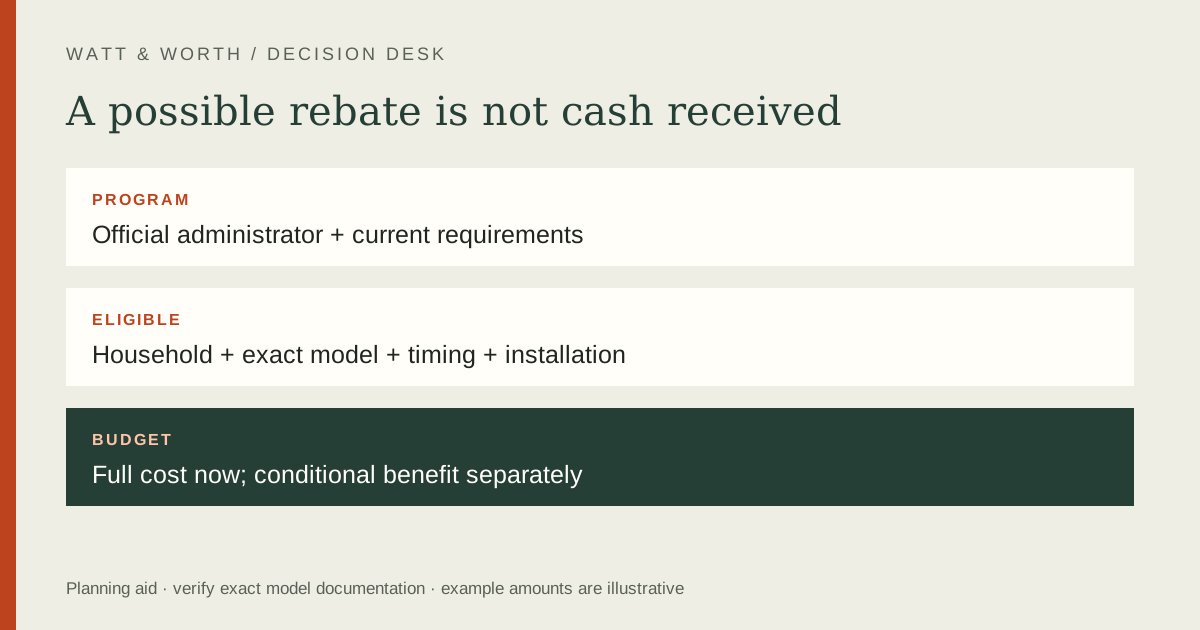
Count an appliance rebate only after verifying the actual program requirements for your household, model and purchase timing. An efficiency label or retailer banner does not establish eligibility by itself. Keep the full purchase budget visible until approval and payment conditions are clear. This guide does not promise a particular benefit amount or describe every state program as currently available.
Identify the real program administrator
Begin with the official utility, state energy office or program website. DOE's Home Energy Rebates page provides a starting point for state and program information. Distinguish a public rebate, utility incentive, manufacturer promotion, retail discount and tax credit; they have different rules and payment mechanisms.
Check the service address and customer eligibility requirements. A program offered in one utility territory or state may not apply elsewhere. If income, property type or ownership status matters, use the administrator's definitions rather than guessing from a general description.
Be cautious when someone guarantees eligibility without collecting the required information. Contact the administrator directly through its official channel. Do not submit sensitive household documents through an unverified link merely because a contractor or advertisement supplied it.
Match the model and the project
| Requirement | Evidence to obtain | Question before purchase |
|---|---|---|
| Eligible equipment | Exact model or approved listing | Does this suffix qualify? |
| Purchase timing | Program dates and invoice rules | Must approval come first? |
| Installation | Contractor and site requirements | Is my installer eligible? |
| Household | Required eligibility documents | Which definition applies? |
| Payment | Method, timing and documentation | Who receives the benefit? |
Do not assume that every certified product qualifies. A program can use a specific model list, equipment category or project requirement. Save the relevant eligibility page and ask the administrator to resolve an ambiguous model before purchase.
Check whether the project includes required electrical work, disposal or installation verification. These can affect both eligibility and net benefit. A rebate that depends on additional work should be evaluated with that work included in the budget.
Confirm timing before committing
Find out whether an application, reservation, assessment or contractor approval is required before purchase or installation. Do not assume reimbursement will be available for a completed project. Rules and available funding can change, so verify the current instructions directly.
Ask which dates matter: order, payment, delivery, installation or application. Keep the required documents in the form the program requests. A retailer receipt that omits model identity or installation details may not answer every documentation requirement.
If the program is not open or eligibility is unresolved, show the purchase without the rebate. You can retain a conditional scenario for planning, but label it clearly. A possible future benefit should not be presented as a guaranteed reduction in today's price.
Calculate cash needed and net benefit separately
Illustrative example: an appliance and installation total $1,400. A possible reimbursement is assumed to be $200 after approval. The household may still need $1,400 at purchase, while a conditional after-reimbursement scenario is $1,200. These are explanatory figures, not current program amounts.
Now suppose a required upgrade adds an assumed $150 that was not needed for the alternative purchase. The net difference attributable to the rebate scenario is not simply $200; the additional required cost also matters. Write the full project comparison before deciding a promotion makes one option cheaper.
Do not combine incentives unless the terms permit it. Ask each administrator about stacking and whether another benefit reduces eligible cost. Tax consequences and credit eligibility require their own current official guidance or qualified advice; this site does not calculate a tax entitlement.
Keep a complete application record
Save the program terms, approval or reservation, invoice, payment evidence, model identity and installation records. Track the submission confirmation and any requests for additional information. Use the official status channel instead of assuming silence means approval.
Ask what happens if a model is substituted, delivery is delayed or installation changes. A replacement that meets your household needs might still need fresh eligibility confirmation. Do not transfer an approval to a different product without checking the program's process.
If a seller advertises a net price after a benefit you cannot verify, compare the actual amount due. Keep marketing separate from the administrator's decision. A purchase should remain affordable under the scenario you are actually authorized to rely on.
A final practical check
Build a document checklist from the current application instructions before submitting anything. Mark which documents are already available and which depend on installation or payment. Ask how corrections to an invoice should be handled if the seller omitted required information. Keep a copy of the final submission and confirmation. This administrative work does not guarantee approval, but it reduces avoidable uncertainty and helps you respond accurately if the administrator asks for clarification later.
Frequently asked questions
Does ENERGY STAR certification guarantee a rebate?
No. It may be one criterion, but the program can impose other model, household, timing and installation requirements. Verify the exact current terms.
Can I apply after I buy?
Only if the actual program allows that process. Some requirements may need to be satisfied before a purchase or project starts. Ask first and keep the answer in writing.
Which other guides help protect the budget?
Use the evidence checklist, read warranty terms and review delivery and returns. A rebate does not remove those separate risks.
Sources
- DOE Home Energy Rebates — program structure and state-office starting points.
- ENERGY STAR Product Finder — model information, separate from program approval.