What to verify before buying an appliance: the evidence checklist
Collect the model identity, installed quote, warranty, recall check and seller terms so your appliance purchase rests on documents rather than assumptions.
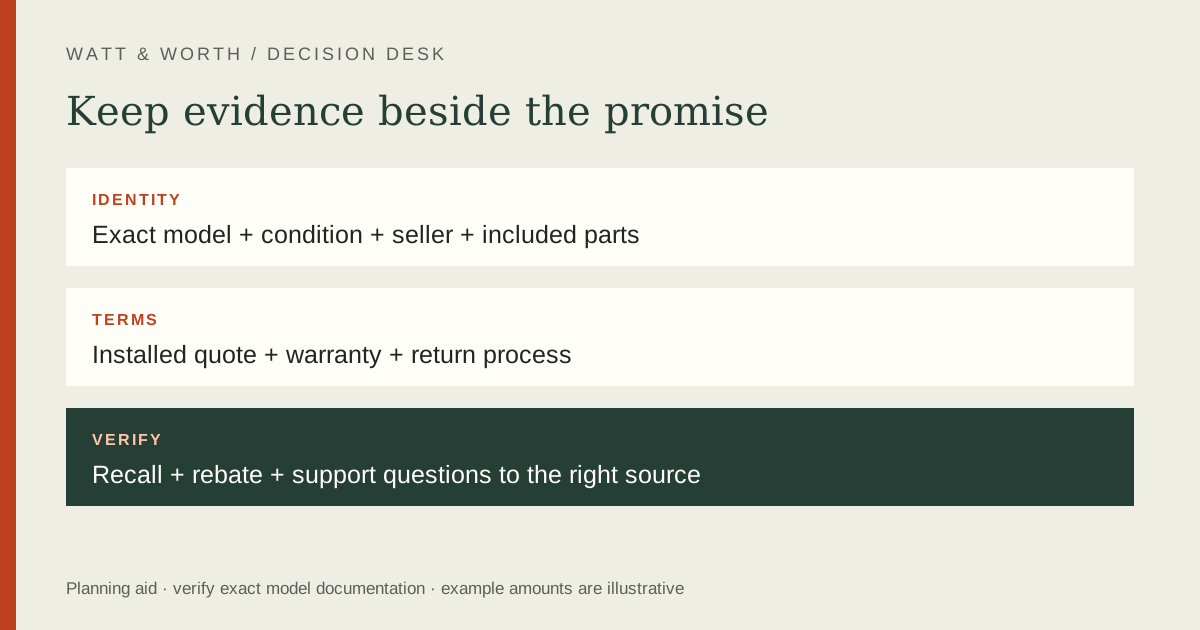
Before buying an appliance, verify the exact product, the full installed price and the written terms for problems after delivery. A polished listing is not the same as a complete offer. Keep a small evidence folder so you can distinguish what the seller has actually promised from what you inferred while shopping. Resolve important gaps before payment.
Establish the identity of the purchase
Record the full model number, condition, seller and included accessories. Marketplace platforms and the business fulfilling an order may be different parties. Identify who takes payment, ships the unit, handles returns and provides any separate seller warranty.
Save the listing and order confirmation. Product-family photographs can show optional accessories or a different configuration. If an item matters to installation or daily use, confirm that it is included rather than relying on an image. Keep optional add-ons separate from the base purchase.
For used or open-box products, obtain information about the specific unit, not just the new product's specification. Ask about visible damage, missing parts, prior use and any account locks for connected equipment. A condition label without a definition leaves important questions unanswered.
Build a small evidence packet
| Record | What it should answer | Where to verify |
|---|---|---|
| Model and serial identity | What exactly is being sold? | Unit, listing and manufacturer |
| Installation manual | What site conditions are required? | Exact manufacturer documentation |
| Installed quote | What must be paid and who does the work? | Seller and installer |
| Warranty | What coverage is included? | Written warranty provider terms |
| Return policy | What happens if the purchase fails? | Actual seller policy |
| Recall search | Is an official safety notice relevant? | CPSC and manufacturer notice |
Do not turn a missing document into a presumed favorable answer. Mark the question open and contact the responsible party. If a seller cannot identify the product or provide essential terms, consider whether you have enough information to proceed at all.
Keep the date of your own document capture, but do not describe it as an independent product review date. This site provides buying guidance and has not tested or inspected the individual unit you may purchase.
Separate warranty, returns and service contracts
A manufacturer warranty describes particular coverage. A seller return policy describes when and how the seller will accept a return. A separately purchased service contract is another agreement. These can overlap, but they are not interchangeable and may have different responsible parties.
Read what is covered, what is excluded, who supplies labor and how a claim starts. Ask whether transport, service visits or diagnostic fees can apply. For a used unit, verify transferability rather than assuming the original warranty follows the appliance.
FTC warranty guidance is a useful starting point. Individual rights and remedies can depend on state law and the actual facts, so consult a state consumer protection office or qualified legal adviser for a dispute. A shopping worksheet cannot determine the outcome of a claim.
Treat rebates and sale claims as separate evidence
An energy-efficiency label does not establish every rebate's eligibility. Verify the program administrator, exact model, purchase window, installation requirements and application timing. Keep an unapproved benefit out of the guaranteed purchase budget.
Illustrative example: a $1,000 installed purchase with a possible $150 rebate still requires a $1,000 budget if the rebate is paid later and not yet approved. A second scenario can show $850 after receipt. This distinguishes cash needed now from a conditional future reimbursement; it is not a statement about a real program.
For a sale, focus on the complete price and actual requirements rather than an unverified comparison price. If financing is included in the sales pitch, read the agreement and total payment obligations. Do not equate a small monthly payment with a low total cost.
Know where to direct the next question
Ask the manufacturer about model specifications and official support policies. Ask the installer about the site. Ask the seller about the order and returns. Ask the program administrator about eligibility. Directing each question to the right party is more useful than collecting multiple vague reassurances.
For a safety notice, use the official recall and the named remedy route. For disposal, consult the local waste program and appropriate EPA guidance. For legal rights, use a state consumer protection office or qualified adviser rather than asking a delivery crew to interpret the law.
Before checkout, write down the remaining uncertainty most likely to change the decision. Resolve that item first. A longer list of minor features should not distract from an unknown installation charge, a missing warranty or an unresolved safety match.
A final practical check
Arrange the folder so another household member can find the warranty and order number without searching through marketing emails. Keep sensitive payment and identity information protected. A useful evidence packet does not need to be elaborate: a model sheet, complete quote, relevant policies and a short list of confirmed answers can be enough. Review it again when the order is finalized, because the selected seller or service package may differ from the one you first researched.
Frequently asked questions
Does a retailer review prove a product is reliable?
It can suggest questions to investigate, but it is not a controlled failure-rate study. Use reviews as leads and verify specific claims against documentation. We do not invent reliability scores from anecdotes.
What if the seller gives a verbal promise?
Ask for the promise in writing and keep it with the order. The FTC specifically recommends written records for warranty-related promises. If the term matters, resolve it before payment.
Where are the detailed guides?
Read warranty terms, open-box buying, recall checks, rebate verification, delivery and returns and recycling preparation.
Sources
- FTC warranties — coverage, written promises and records.
- CPSC recalls — original safety notices.
- DOE Home Energy Rebates — starting point for program and state information.