How to check an appliance recall before buying or selling
Match a product to CPSC recall notices using model, serial and other identifiers, then follow the official remedy instead of guessing from a brand name.
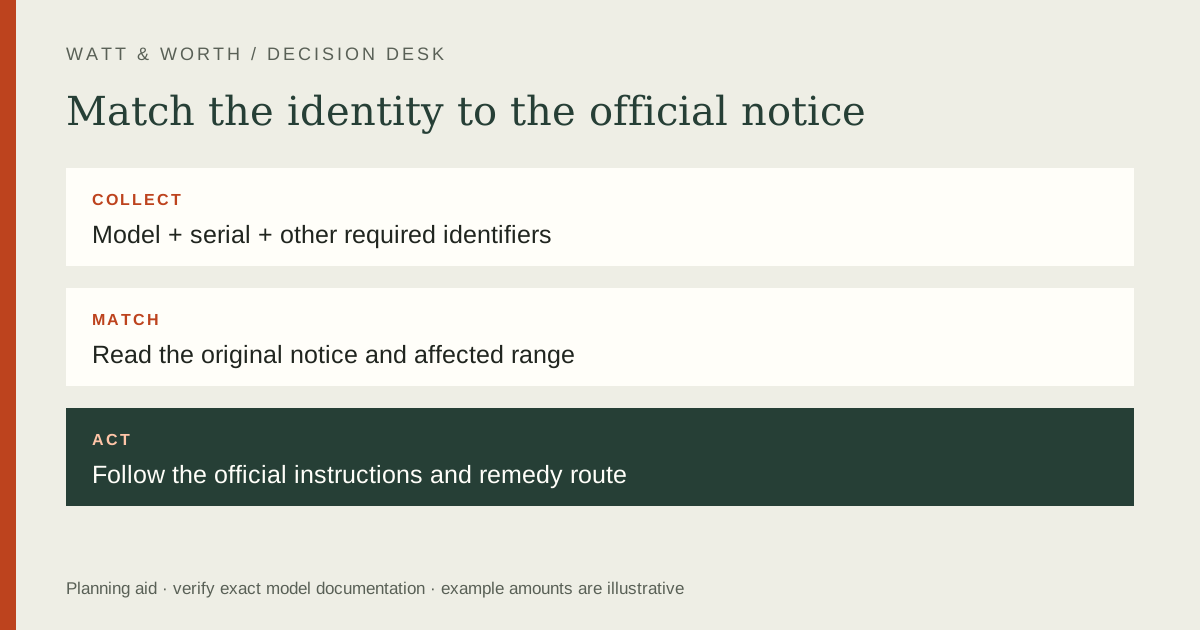
Check an appliance recall using the exact product identity and the official notice. Brand name alone is not enough: model, serial range, date codes or other identifiers may determine whether a unit is affected. If a notice matches, follow its stated action and remedy. This guide does not inspect products or certify that a unit is safe because a search returns no result.
Collect identifiers before searching
Find the model and serial information in the location described by the manufacturer. If accessing it would require unsafe movement or disassembly, ask the seller, manufacturer or qualified service provider for help. Do not risk injury to read a label.
Record the identity exactly, including letters, hyphens and suffixes. For a used purchase, ask for a clear photograph of the actual unit's plate rather than a model copied from a generic listing. Keep the seller's description and the photograph together so mismatches are visible.
Some notices use additional identifiers, production dates or distinctive features. Read the original notice to learn what matters. A similar appearance can be a reason to investigate, but it does not establish a match or exclusion by itself.
Search the original notice
Use CPSC's recall resources and the manufacturer's official recall information where relevant. Search more than one identifier if a first query is ambiguous. Read the notice itself rather than relying on a search-result summary or a social-media screenshot.
| Notice field | What to compare | What to avoid |
|---|---|---|
| Product name | Type and description | Brand-only assumptions |
| Model | Full exact identity | Dropping suffixes |
| Serial or date range | Actual unit's identifier | Guessing from purchase year |
| Hazard and action | Stated instructions | Improvised testing or repair |
| Remedy contact | Official route in notice | Unverified third-party links |
Keep a copy or reference to the notice and note when you checked it. A search today is not a promise that no future notice will appear. If a product is important to your household, retain the identity information so later checks are possible.
Resolve uncertain matches directly
If the model matches but a serial range is unclear, contact the manufacturer using the official route. Ask which identifiers it needs and retain the response. Do not decide a unit is unaffected because one number is hard to read.
If the seller says a remedy has already been completed, ask for appropriate documentation and compare it with the actual recall instructions. A general statement that a product was “serviced” is not necessarily evidence of the recall remedy. The official notice and manufacturer can clarify the process.
Do not create your own repair to bypass the stated remedy. A buying guide cannot determine whether an alteration addresses a hazard. If the notice says to stop using the product, follow that instruction rather than continuing operation while negotiating a discount.
Use the result in the purchase decision
A matching unresolved notice changes the next step from ordinary price comparison to following the official action. Do not treat the hazard as a bargaining chip that can simply be priced into an ownership worksheet. Resolve the safety question through the notice's remedy route.
An absence of a matching search result is narrower evidence. It means your search did not identify a relevant notice under the information used. It does not verify condition, installation, authenticity or every potential hazard. Keep the normal inspection and installation checks.
Illustrative identity example: a notice might apply to model ABC-100 within a specified serial range. A product listed only as “ABC series” cannot be classified without the actual identifier. These are invented identifiers for explanation, not a real recall or a claim about a manufacturer.
Prepare for resale or disposal responsibly
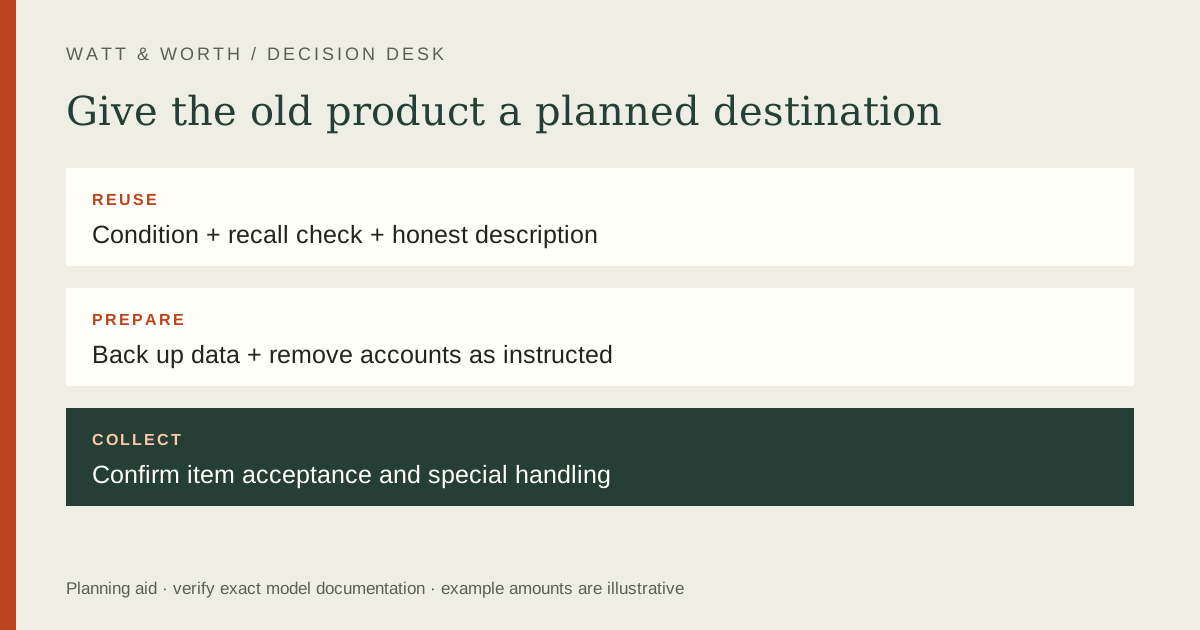
Before selling or giving away a used appliance, check the identity and current safety notices again. Use CPSC's official guidance for questions about recalled products rather than assuming a free transfer is outside the concern. If a remedy or disposal action is specified, follow the original instructions.
Do not remove identifying labels to make a unit easier to sell. A future owner needs those records for service and safety checks. For connected products, handle account removal separately through the manufacturer's legitimate process; a reset does not resolve a physical recall.
If disposal is required, ask the relevant local program or service about the product and condition. Refrigerants, batteries and other components may need specific handling. Do not dismantle equipment or place potentially hazardous components in ordinary waste based on a generic online tip.
A final practical check
For a household with several similar appliances or devices, label your private records clearly so one unit is not confused with another. Record the room or use alongside the model and serial identity. When a notice is updated, repeat the match using the actual unit rather than relying only on an earlier search note. Do not publish serial photographs with unrelated personal information. The purpose of the record is accurate follow-up, not a public claim that the product has been certified safe.
Frequently asked questions
Does a recall cover every product from the same brand?
Read the notice. Coverage is defined by its stated identifiers and conditions, not by broad brand association. Verify the actual unit rather than making either an inclusive or exclusive assumption.
Can a seller's repair receipt prove the remedy is complete?
It may be useful evidence, but compare the work with the official recall remedy and ask the manufacturer if unclear. A receipt for unrelated service does not answer the recall question.
What other purchase checks remain?
Use the evidence checklist, open-box guide and delivery guide. A recall search complements those checks; it does not replace them.
Sources
- CPSC recalls — original notices, identifiers and stated remedies.
- CPSC recalled-product resale guidance — official guidance on checking used products before resale.