How to measure for an appliance: opening, operation and delivery route
Measure the appliance opening, working clearances and full delivery path, then compare the exact manufacturer drawing before placing your order.
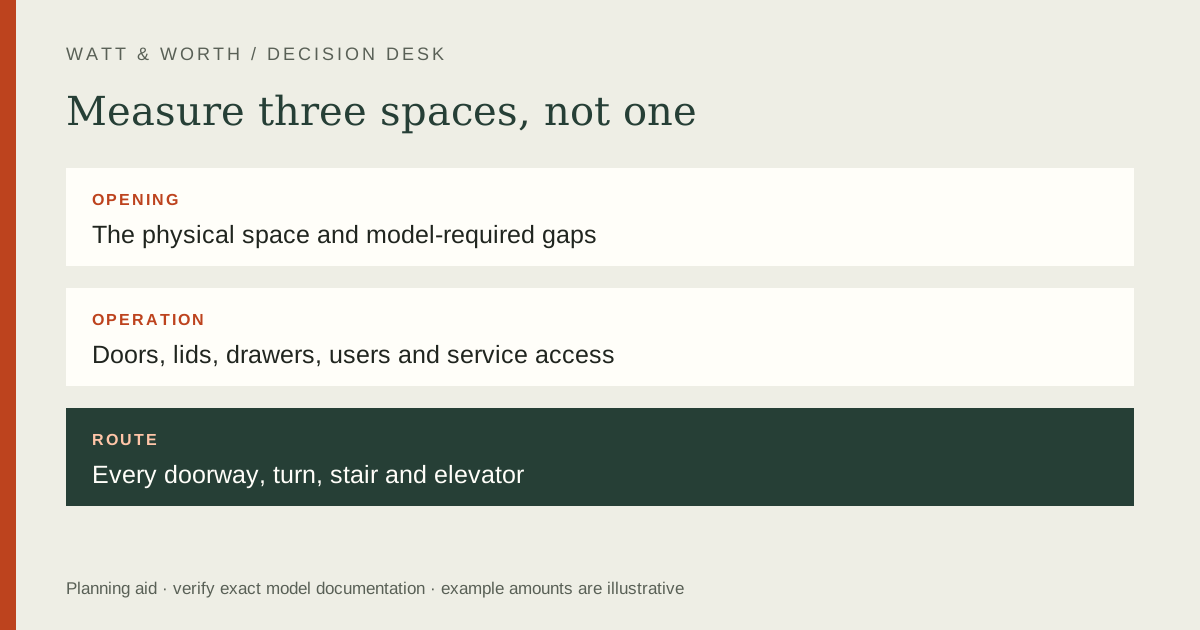
Measure three spaces before ordering an appliance: the installation opening, the space it needs to operate and the route it must travel to get there. Compare all three with the exact model's dimensional and installation drawings. A machine that fits between cabinets can still fail because its door cannot open or the delivery team cannot reach the room.
Make a simple site drawing
Sketch the opening from the front and above. Mark nearby walls, counters, handles, baseboards and utility connections. Write the measurements directly on the sketch and note where each was taken. Take several readings where floors or walls appear uneven rather than assuming the space is perfectly square.
Measure width, height and depth using consistent units. US listings commonly use inches, but a manual may also show metric dimensions. Convert carefully and retain the original measurement. Do not round a tight clearance in the direction that makes the model appear to fit.
Photograph the area without exposing personal information unnecessarily. Pictures help explain the arrangement to the seller or installer, but they do not replace dimensions. Keep utility access and service access on the drawing as well as the visible appliance body.
Separate closed size from working size
| Space | What to check | Common omission |
|---|---|---|
| Appliance body | Width, height and depth | Handles or rear projections |
| Installation envelope | Model-required gaps and connections | Hoses, plugs or ventilation |
| Operating envelope | Door, lid or drawer movement | Adjacent wall or cabinet |
| User access | Loading and control reach | Aisle blocked during use |
| Service access | Filters and maintenance panels | Unit must move for routine care |
Use the exact manual for required clearances. There is no safe universal rule that every refrigerator, dryer or dishwasher needs the same gap. A retailer's product-card dimensions may omit the working details that decide the installation.
Illustrative geometry: a body depth of 28 inches plus an assumed 3-inch rear allowance creates a 31-inch planning depth before any additional handle projection. This is not an installation recommendation. Substitute the actual drawing and required allowance for the selected model.
Walk the entire delivery route
Start at the unloading point and follow the route to the final position. Check entrance width and height, hallway turns, stairs, elevator dimensions and door hardware. Record the narrowest clear opening rather than the nominal door size. Ask the delivery company what dimensions it needs for its equipment and handling method.
A turn can be harder than a straight doorway. The appliance, packaging and moving equipment need a workable path, not simply one adequate measurement. If the route is close, arrange a professional assessment rather than attempting a geometric guess from a product photo.
For apartments or managed buildings, check elevator reservations, service entrances, allowed delivery hours and insurance documentation if required by the building. Obtain permissions before booking a nonrefundable service. Tell the seller about stairs or special access because those can affect the quoted service.
Confirm the plan with the installer
Send the drawing and exact model number to the person responsible for installation. Ask whether connection locations or existing conditions create extra work. If a site visit is required, obtain it before treating an estimate as final. An online shopping cart cannot assess unseen site conditions.
Do not remove an appliance door, cabinet or building fixture merely because doing so appears to solve the route. Ask whether the manufacturer and delivery provider permit the handling method, who performs it and whether reassembly is included. Improvised disassembly can create damage or safety problems.
Clarify responsibility if the unit cannot be delivered or installed. Ask about redelivery, return transport, restocking and cancellation terms. Keep the answer with the order confirmation. A promise that “it should fit” is less useful than a written route assessment tied to the exact model.
Recheck after any model change
A different finish, capacity or product suffix can mean a different dimension. If the seller proposes a substitute, compare the drawing again. Do not transfer your fit approval automatically because the alternative belongs to the same brand or nominal size class.
Check the delivered identity before installation. If it differs from the order, stop and resolve the mismatch through the seller. Photograph visible damage and follow the reporting process promptly. Keep the measurements and original quote available in case the scope changes.
Once installed, verify that doors, drawers and adjacent fixtures work as planned. Confirm access for regular maintenance and save the manual. Measuring is not just a pre-purchase exercise; the final check establishes whether the installed arrangement actually matches the agreed plan.
A final practical check
Check the room after clearing removable clutter, but do not plan around removing permanent safety features or required access. Note which obstacles can legitimately be moved and who will move them on the day. If furniture must be relocated, include a safe place for it during delivery. A route that exists only on paper because the hallway is full of displaced belongings is not ready. Walk the prepared path again before the scheduled appointment.
Frequently asked questions
Can I use the dimensions of my old appliance?
Use them only as a reference. Measure the actual opening and compare the new model's full drawing, including required gaps and working movement. The same nominal size does not guarantee identical fit.
What if the opening is only slightly too small?
Ask the installer or appropriate building professional to assess options. Do not reduce manufacturer-required clearances or force an unsuitable connection to make a purchase work.
Which planning guides go with this one?
Return to the purchase plan. Read ownership cost to budget site work and repair or replace if installation makes replacement unexpectedly costly.
Sources
- FTC appliance shopping and EnergyGuide guidance — measure appliance space and opening clearance.
- ENERGY STAR clothes dryers — capacity and installation-related buying considerations.