Total appliance ownership cost: a two-option worksheet
Compare appliance purchase, installation and annual running costs over an explicit period, with sensitivity checks and exclusions made visible.
Compare total planned ownership cost by adding the installed purchase cost to recurring costs over the same chosen period. Keep uncertain repairs, rebates and resale values visible rather than hiding them inside a confident total. The result is a decision scenario based on your inputs, not a promise of how long either appliance will last or what future bills will be.
Define what is included
Begin with tax-inclusive purchase price, delivery, installation, required accessories and removal. Use written quotes where possible. Separate optional upgrades so you can tell whether an apparent price difference comes from the appliance or a different service package.
For annual running cost, consider electricity, water, sewer, gas, filters, subscriptions and other recurring supplies that differ between the options. Exclude costs that are identical if the purpose is simply to compare the difference, but document that choice. Avoid adding an annual estimate and its components together.
Choose a planning period that fits the decision. Expected time in the home, planned use and budget priorities can matter. A ten-year worksheet is not a claim that an appliance lasts ten years. Test a shorter period when the answer depends on distant savings.
Calculate the base scenario
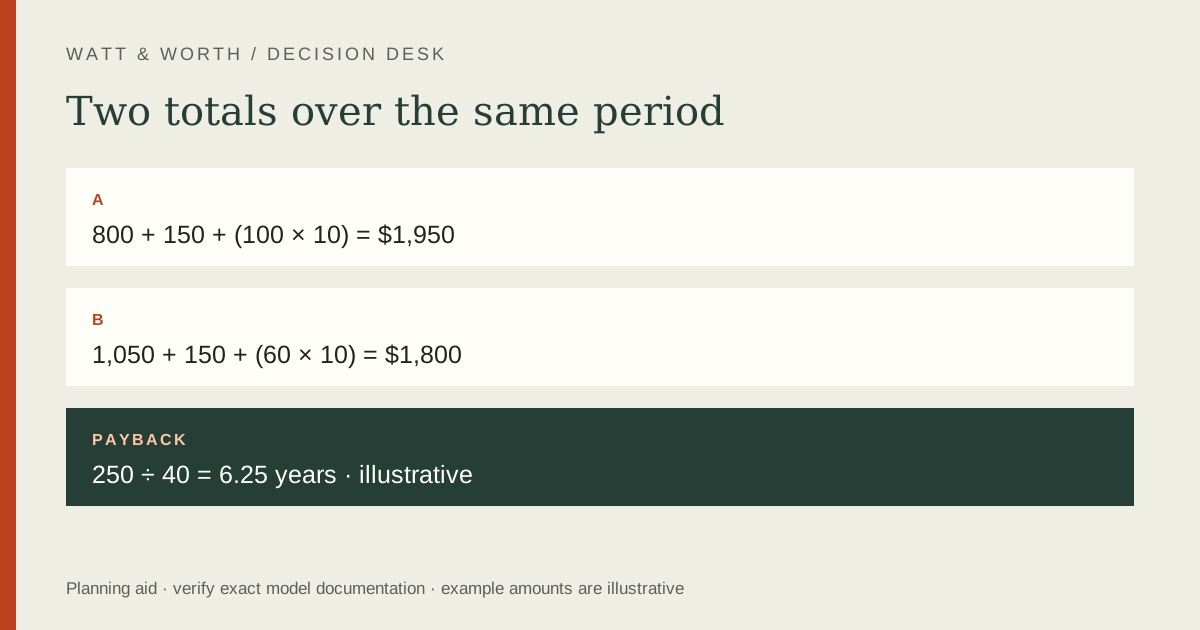
Illustrative example: A costs $800 to buy, $150 to install and $100 per year to run. B costs $1,050, $150 and $60 respectively. Over ten assumed years, A totals $800 + $150 + $1,000 = $1,950. B totals $1,050 + $150 + $600 = $1,800.
The difference B minus A is −$150. That means B is $150 cheaper in this particular scenario. At five years, A is $1,450 and B is $1,500, so A is $50 cheaper. The planning period changes the result even though the product assumptions remain the same.
| Cost component | A, illustrative | B, illustrative |
|---|---|---|
| Purchase | $800 | $1,050 |
| Installation | $150 | $150 |
| Annual running | $100 | $60 |
| Five-year total | $1,450 | $1,500 |
| Ten-year total | $1,950 | $1,800 |
Interpret payback carefully
Simple running-cost payback divides the additional upfront cost by annual savings. Here, B costs $250 more initially and saves an assumed $40 each year, giving 6.25 years. That is the point at which those assumed savings equal the extra initial cost, ignoring discounting and other changes.
If B has no annual savings, there is no running-cost payback to calculate. If B is already cheaper up front, no extra initial outlay needs recovery. A tool should explain those cases instead of producing an infinite or negative date that looks like a meaningful prediction.
Payback does not establish affordability or reliability. A household may prefer a lower upfront cost because cash is limited, or may pay more for a necessary accessibility feature. Keep the cost result alongside the fit and functional requirements rather than treating the smallest total as an automatic instruction.
Run sensitivity checks before deciding
Change one assumption at a time. Try a shorter period, a different utility rate and a plausible variation in annual use. If a small change reverses the result, describe the decision as sensitive to that assumption. Do not turn a fragile estimate into a confident claim of savings.
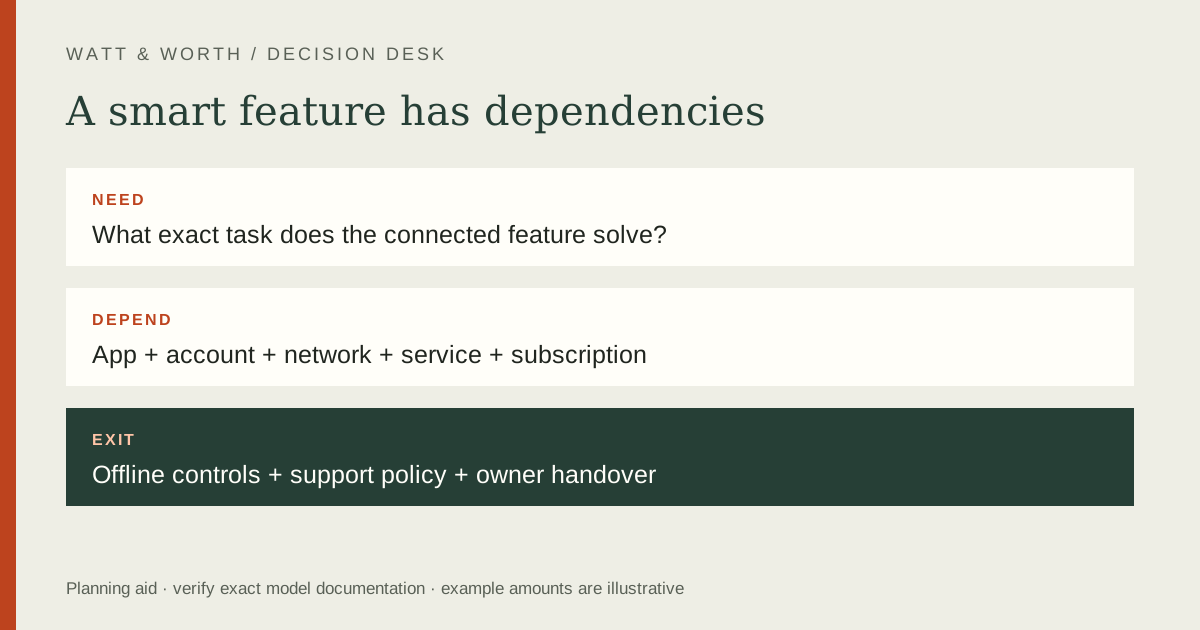
Use actual replacement filter prices and a documented schedule where available, but label the schedule as an assumption if conditions affect replacement. A subscription advertised as optional should be checked against the feature you need. The cost of preserving that feature may be different from the cost of basic operation.
Repairs need special care because future failures are uncertain. Without reliable evidence, do not assign invented failure probabilities. You can show a separate repair scenario to understand budget exposure, but do not present that scenario as an expected cost or a comparative reliability rating.
Keep financing and incentives separate
The ownership calculator uses undiscounted cash amounts and constant annual costs. It does not model interest, deferred-interest terms, changing tariffs or resale. If financing matters, compare the actual agreement's total payments and fees separately.
Treat an unapproved rebate as conditional. Show the purchase budget before the rebate and a second scenario after verified eligibility. Include application costs or required work if they affect the real benefit. A tax credit, retail discount and reimbursement are different mechanisms and should not be combined casually.
Save the worksheet with the quote dates and source documents. Update it when the seller changes installation scope or substitutes a model. A useful result is tied to the actual purchase being considered, not an earlier listing with a similar name.
A final practical check
Give every input a status: quoted, documented, assumed or excluded. For example, installation may be quoted while annual filters remain an assumption. This small annotation tells you where another phone call or document could improve the comparison. It also prevents an illustrative default from surviving into the final purchase decision unnoticed. Before saving the result, review the largest uncertain input first rather than polishing cents on a much smaller, already documented cost.
Frequently asked questions
Should I include the old appliance's original price?
For a forward-looking replacement decision, money already spent is separate from the costs you can now change. Compare future repair, continued use and replacement scenarios, including any real disposal or resale consequences.
Can this determine which model is most reliable?
No. Cost arithmetic does not measure failure rates. Use the warranty, service availability and appropriate independent evidence without inventing statistics where none are available.
Which other steps matter?
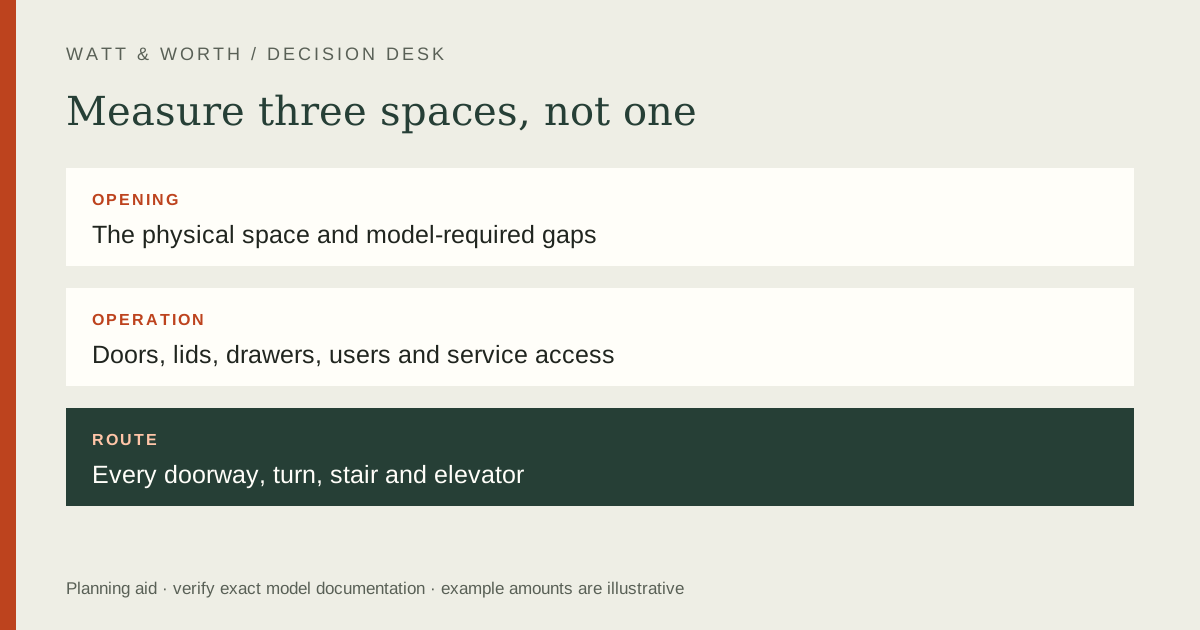
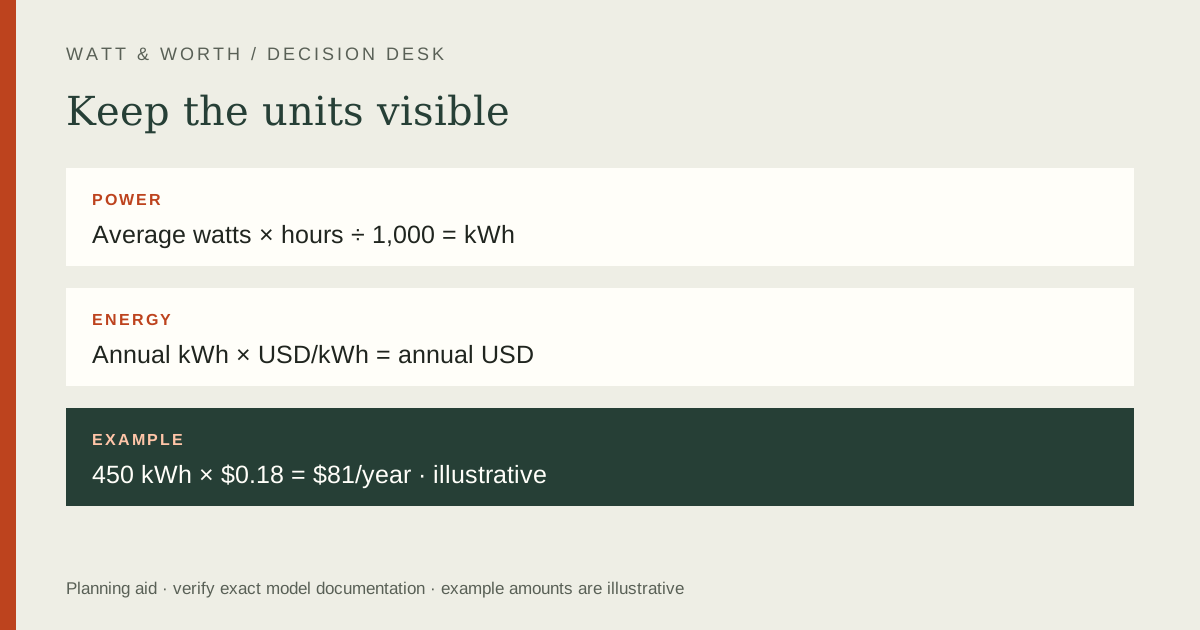
Follow the purchase plan, verify electricity arithmetic and check measurements. A financially appealing option still needs to fit and be installed correctly.
Sources
- FTC EnergyGuide explanation — operating estimates have assumptions.
- CFPB deferred-interest explanation — why financing needs its own review.