Appliance electricity cost: watts, kWh and the rate on your bill
Calculate appliance electricity cost from annual kWh or measured average watts, with clear unit conversions and limits for cycling equipment.
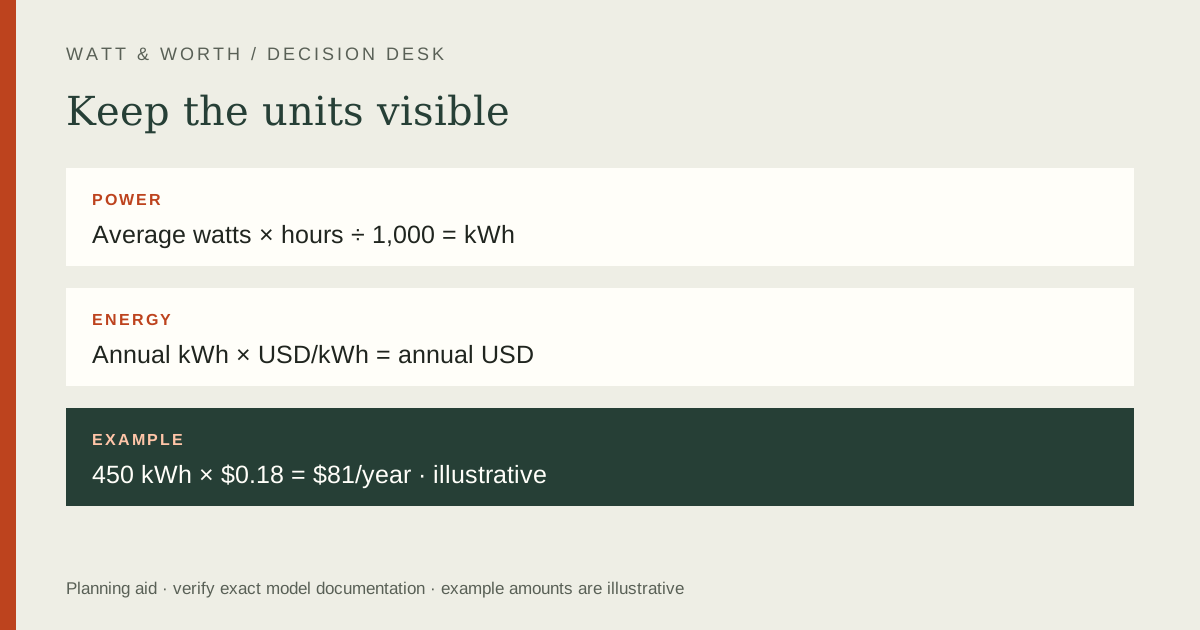
Appliance electricity cost is energy in kilowatt-hours multiplied by the applicable dollars per kilowatt-hour. If you begin with watts, multiply average watts by operating hours and divide by 1,000 to obtain kWh. The difficult part is choosing representative inputs. A nameplate power rating is not automatically the average draw of equipment that cycles or changes operating modes.
Keep power and energy separate
Watts describe a rate of electricity use. Kilowatt-hours describe energy accumulated over time. A 1,000-watt load running for one hour uses one kWh; the same load running for half an hour uses half a kWh. These are unit relationships, not product efficiency claims.
For an appliance with a documented annual kWh figure, use that figure directly rather than converting from an unrelated wattage. Keep the source and its assumptions. For a device measured at home, record the period, operating settings and whether the measurement represents normal use.
Do not estimate a refrigerator's yearly energy simply by multiplying its maximum rated watts by every hour of the year. Equipment that switches on and off or varies output needs an appropriate average or a longer measurement. Use safe, suitable measurement methods and follow the equipment instructions.
Work through a transparent example
Illustrative desk-device scenario: average draw is assumed to be 60 watts during eight hours of use each day, for 250 days. Energy is 60 × 8 × 250 ÷ 1,000 = 120 kWh. At an illustrative rate of $0.20 per kWh, the use-period cost is $24.
If standby is estimated separately at an assumed 2 watts for the remaining 6,760 hours, it adds 2 × 6,760 ÷ 1,000 = 13.52 kWh, or $2.704 at that rate. Combined energy is 133.52 kWh and the rounded cost is $26.70. The example is not a claim about any actual device.
| Input | Unit | Check |
|---|---|---|
| Average power | watts | Appropriate setting and measurement period |
| Operating time | hours | No overlap between modes |
| Energy | kWh | Divide watt-hours by 1,000 |
| Electricity rate | USD/kWh | Convert cents to dollars |
| Annual cost | USD/year | Energy and rate use matching periods |
Choose a rate that matches the question
Find the charges that change with electricity use on your utility bill. A rate quoted in cents needs conversion: 20 cents per kWh is $0.20 per kWh. Do not enter 20 into a dollars-per-kWh field unless your intended assumption really is twenty dollars.
Fixed monthly customer charges typically do not change when one appliance changes. Exclude unchanged charges when comparing two models. If your tariff has tiers, time-of-use pricing or other variable components, determine which charges apply to the additional or avoided use. Ask the utility when the bill is unclear.
For a simplified time-of-use scenario, calculate each time block separately and add the costs. A single weighted rate can work if you know the distribution of use. Do not describe a broad average as an exact marginal rate, and do not assume scheduled operation always reduces cost without checking the tariff.
Match annual use to the appliance
An EnergyGuide estimate is a standardized starting point. The FTC explains that actual operating cost depends on use and local energy prices. Keep the published energy amount separate from a household adjustment so readers of your worksheet can tell which number is documented and which is assumed.
Some appliances involve other resources or fuel. A washer, gas dryer or dishwasher comparison may require water, gas or water-heating information. An electricity-only calculator cannot represent all of those costs unless you intentionally convert and document an appropriate combined estimate elsewhere.
Use the energy calculator for annual kWh arithmetic. It holds the rate constant and multiplies by your chosen years. It does not retrieve a tariff, forecast inflation or predict equipment life. Put those limitations next to any result you save.
Test whether the result matters
Try a reasonable lower and higher rate or usage assumption. If the difference between two appliances remains small compared with installation cost, focus on the other decision factors. A spreadsheet can display cents without making a rough scenario precise.
Illustrative comparison: a 75 kWh annual difference costs $11.25 at $0.15 per kWh and $22.50 at $0.30. An extra $300 purchase cost would take about 26.7 or 13.3 years respectively to recover through that electricity difference alone. These are scenarios, not durability forecasts.
Save the calculation with the model identifiers, source energy data, rate and period. If you later change one input, update the conclusion too. A useful worksheet is one whose answer can be reproduced, not one with the most complicated formula.
A final practical check
If your measurement covers only a short period, state that period beside the result and explain how you extended it. A week during unusual use may not represent a year. Seasonal conditions, holiday guests or a temporary work pattern can change the comparison. Prefer a representative documented figure where available, and treat extrapolation as an assumption. Keep a separate note for any usage you deliberately omitted so the result can be reproduced or corrected later.
Frequently asked questions
Can I multiply the label's annual dollar cost by my rate?
No. That would multiply money by a rate. Use an appropriate annual energy quantity with your rate, or keep the published dollar estimate with its original assumptions.
Does a higher wattage always mean higher annual cost?
No. Operating duration and the actual average draw matter. Compare the same task and include relevant modes rather than judging by a maximum power number alone.
How do I include purchase cost?
Read total ownership cost and the purchase plan. The repair decision shows why running-cost savings are only one part of replacement.
Sources
- FTC EnergyGuide explanation — standardized cost estimates versus personal use and rates.
- ENERGY STAR Product Finder — source for model energy information where provided.